
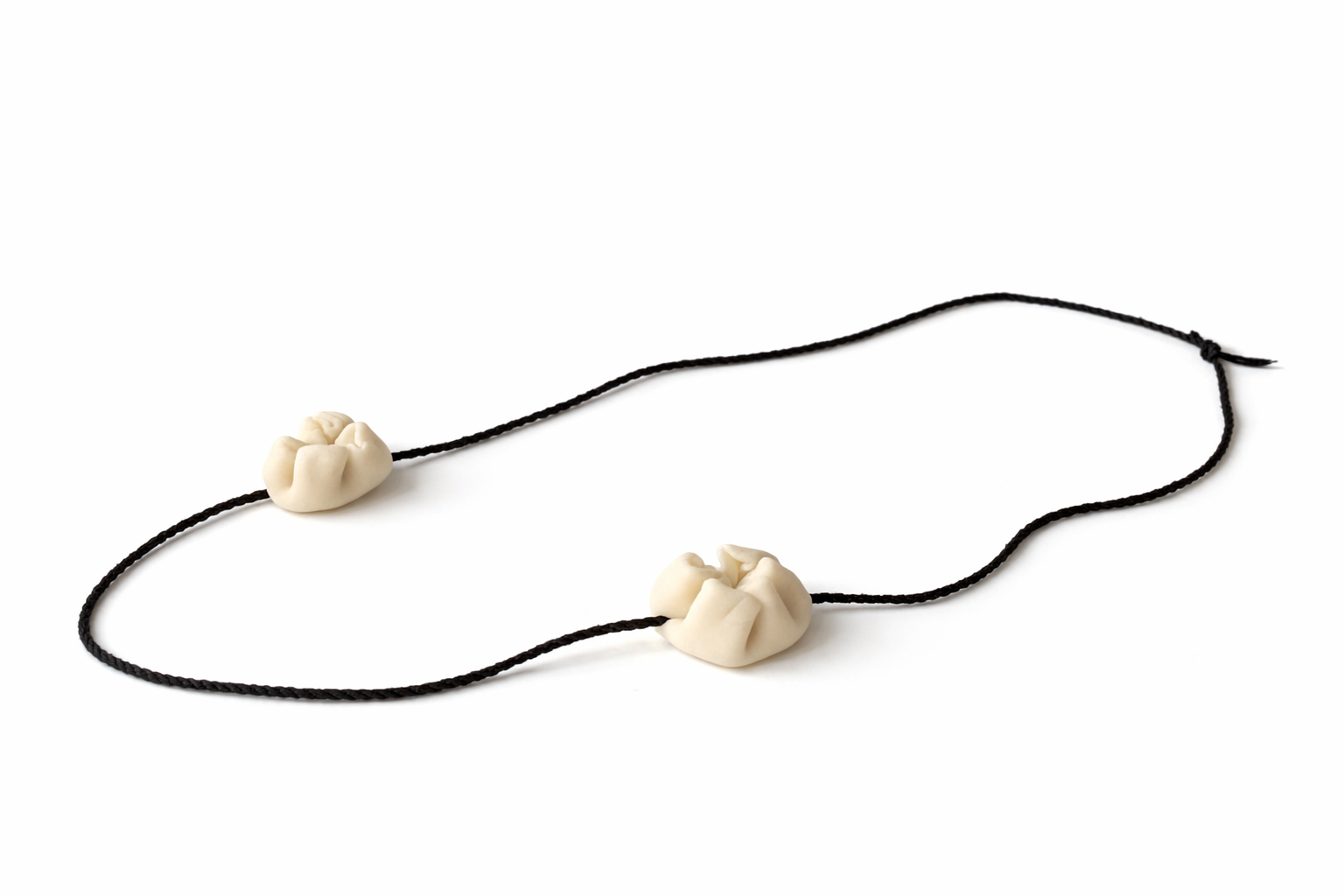
This exhibition has lived quietly in my mind for years, like a recipe memorized but never yet cooked. I always knew it would be about dumplings. Not simply as food, but as symbol – as gesture, as memory, as a small and universal act of care. Dumplings felt like the perfect metaphor for connection, something the world seems to be craving more than ever. Nearly every culture holds its own version: pierogi, momo, ravioli, empanadas, wontons. Each one carries its own history, yet they all share the same essential language of hands, filling, folding, and offering.
Across histories and geographies, dumplings have often emerged from necessity as much as celebration. Stories trace them to moments of healing, to ingenuity during harsh winters, to the simple desire to stretch ingredients so more people could be fed. Over time, they became more than sustenance. They evolved into symbols of prosperity, reunion, and care – foods made in multiples, meant to be shared, rarely prepared for one. Their circular or crescent forms frequently echo ideas of wholeness, continuity, and fortune. What is remarkable is how consistently dumplings appear at thresholds: new years, harvests, family gatherings, departures, returns. They are foods of transition, quietly marking time while grounding people in ritual.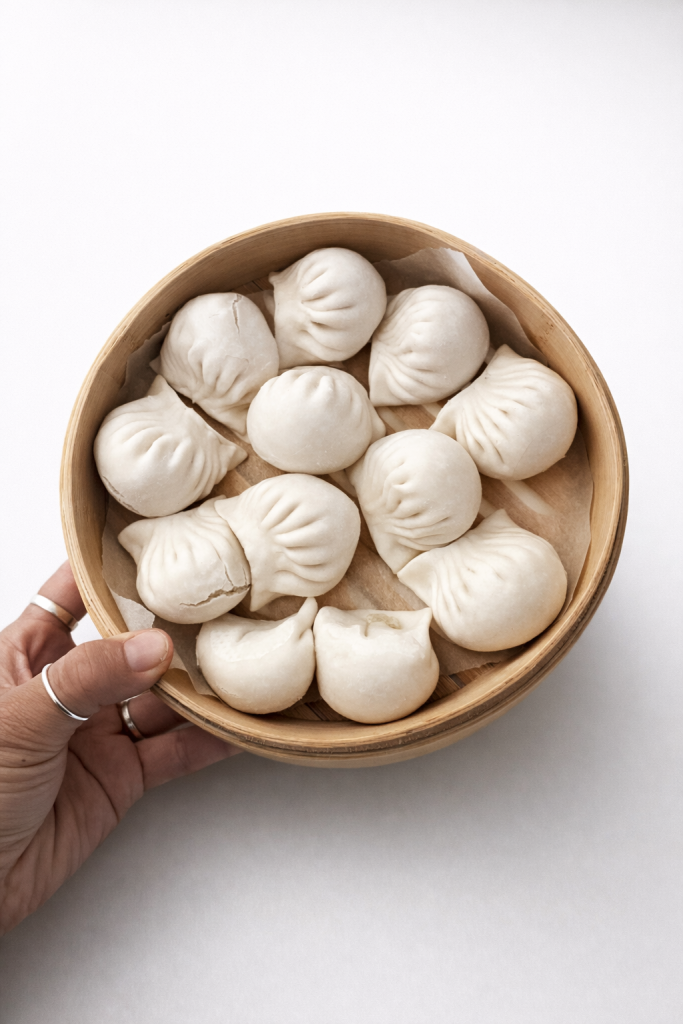
A dumpling is, at its core, a small packet. It can be filled or left empty. It is humble and unassuming, yet deeply personal. It is both communal and intimate. These small parcels of dough are made slowly, often together, and rarely in silence – or, perhaps more accurately, never without communication. Even when words are absent, stories pass between fingers. Recipes are inherited through muscle memory. Care is transferred through repetition.
As a child, language created a barrier between my grandmother and me. We did not share the same words, and that absence formed a quiet gap between us – a missing link to my Chinese culture that I could sense but not articulate. Yet in the kitchen, that gap softened. When we cooked together, our hands became our voices. Rolling, pinching, folding – these gestures became sentences. Knowledge was exchanged through touch rather than translation. It was here that I first understood making as a form of language, one that existed beneath and beyond speech.
Years later, I found myself back at a kitchen table, this time sitting beside my young son with playdough spread between us. Again, there were few words. Again, there were hands. I rolled small shapes, and he mimicked them. I folded layers, and he followed. The same quiet choreography resurfaced across generations, transformed but intact. In that moment, the work for this exhibition truly crystallized. What I had once experienced with my grandmother was now unfolding again, reframed through motherhood – proof that making is not only a way to preserve culture, but also a way to build new connections in the present.
In Chinese culture, dumplings can symbolize comfort and hope – two things the world seems to be in dire need of right now. Often translated as ‘a steamy hug’ or ‘wrappers of joy,’ dumplings are more than food – they are small expressions of love shaped by hand. Across cultures, they carry warmth, care, and generosity, offered from one person to another in quiet, tangible form. They are often made during times of gathering and celebration, moments when families come together to mark transitions, endings, and beginnings. This symbolism resonates deeply with the themes in Around the Kitchen Table: care, continuity, and the quiet resilience found in shared rituals.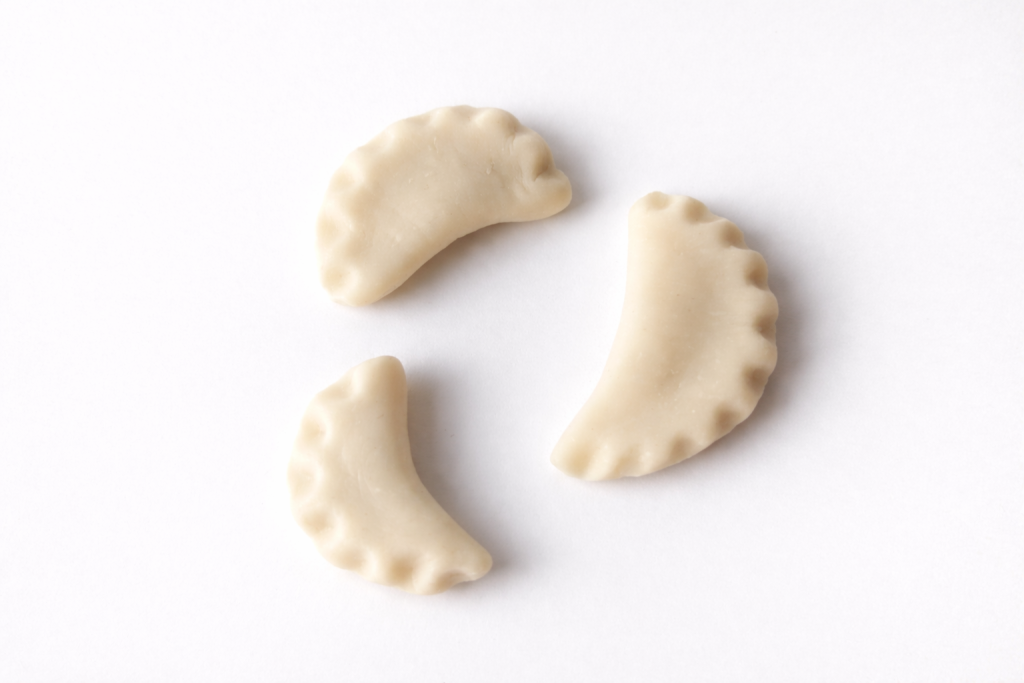
Jewellery, like dumplings, exists on an intimate scale. Both are small objects that hold immense meaning. Yet working at this scale also presents a temptation – to add more, to embellish, to fill every available space. During the development of this exhibition, the display went through many iterations, some maximalist and dense, others sprawling with supporting structures and auxiliary works. But the heart of this project has always been about refinement. About slowing down.
About removing the unnecessary and extracting the essence.
Where the exhibition ultimately landed is in restraint. In allowing space for breath. In recognizing that a small object, thoughtfully made, already carries weight. Just as a dumpling does not need excess filling to be meaningful, a piece of jewellery does not need ornamentation to speak. The power lies in the gesture – in the roll, the fold, the pinch – and in the intention held within those movements.
The display apparatus received as much care and deliberation as the jewellery itself, much like the vessel that holds dumplings is considered with the same respect as the dumplings within it. I wanted the structures to carry meaning without competing for attention – to cradle the work rather than overshadow it – echoing the quiet role of a steamer basket or serving plate that supports the meal without demanding focus. Many of the elements were refurbished or repurposed: old baking sheets given a fresh coat of paint, bamboo steamer baskets borrowed from my own kitchen, and a discarded table missing its leaf that found new purpose rather than ending up as waste. This gesture of extending an object’s life mirrors the ethos of dumpling-making itself – a tradition born from resourcefulness, from stretching ingredients and finding value in what already exists. Although the primary material in the pieces is new clay, subtle reclaimed components are woven throughout – mason jar lids transformed into magnetic fasteners, worn shoelaces reimagined as neckpieces – small reminders that renewal and reuse can coexist with refinement, just as leftover dough is folded again into something nourishing and whole. 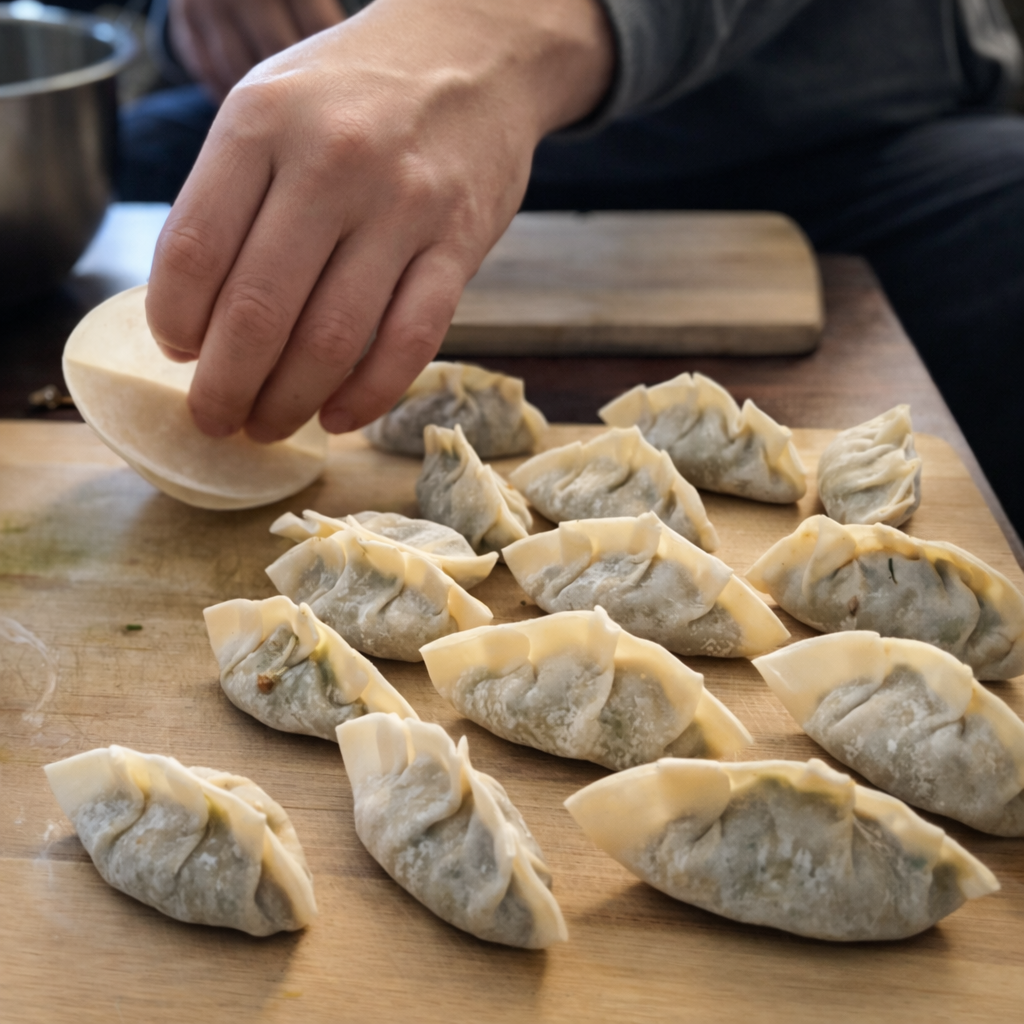 From the outset, I knew a participatory element would be essential to this exhibition. There is a particular beauty in the communal making of food and in witnessing many interpretations of a single form – how one gesture can hold countless meanings across different hands. While my own history is closely tied to dumpling-making, it felt important to open that space for others to share their stories as well. This invitation asks visitors to pause and consider whether dumplings exist in their own memories: perhaps as a family recipe, a holiday ritual, or a scent that returns them to a childhood kitchen. And if they do not, what might a dumpling look like if they did?
What shape would comfort take, what folds might represent gathering, warmth, or hope? The act of making a dumpling is inherently repetitive and meditative, rhythmic and grounding. It often unfolds around a table where conversation flows easily, or where silence feels equally full.
Hands begin to move almost instinctively – shaping, folding, pinching – and in that quiet choreography the dumpling shifts from being merely food into something more symbolic: a small vessel carrying culture, memory, and care from one person to another.
Around the Kitchen Table is a welcome to consider making as communication, and the table itself as a site of transmission. It speaks to the languages we inherit, the ones we never gain, and the ones we recreate with our hands. Dumplings become a recurring motif for these exchanges: small packets passed from palm to palm, carrying food, memory, care, and time. In their modest scale they hold immense meaning, bridging generations and cultures through repetition and ritual. What appears simple – a fold, a pinch, a shared surface – reveals itself as a powerful act of continuity, where silence is not emptiness but a space filled with intention, and where the smallest gestures become vessels for connection.
artist bio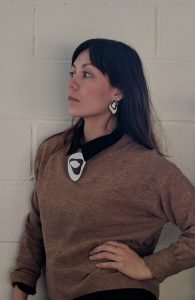
Clarissa Long is a Canadian artist based in Vancouver, British Columbia, living and working on Coast Salish Territory. She holds a BFA in Jewellery and Metalsmithing from NSCAD University. Working with mixed materials that are recycled or sustainably sourced, she creates wearable art and installations that explore contrast, materiality, and identity, often informed by her mixed-race background.
Her work has been exhibited internationally, including at Talente in Munich, Germany, and the Beijing International Jewellery Exhibition in China. She has been recognized for her innovative approach as a finalist for Western Livingmagazine’s Designer of the Year and as a past winner of the Niche Awards.
An active advocate for the contemporary art jewellery community, Long is an instructor in the LaSalle College jewellery diploma program and has served as Chair of Exhibitions for the Vancouver Metal Arts Association. Her curatorial projects include The Maker’s Mark at Burrard Arts Foundation and Disrupt at the Craft Council of British Columbia.
